
Introduction from the perspective of active amateur radio operators.
By KG5WHQ
You’ve just finished a solid pass on SO-50 or RS-44. The Arrow is still warm in your hands, the dual-band HT is cooling down, and you’re already wondering about the next workable bird. Or maybe you’re a Technician who’s heard the stories about working the ISS or linear birds and you’re tired of jumping between Heavens-Above, AMSAT status pages, Doppler calculators, and space-weather sites.
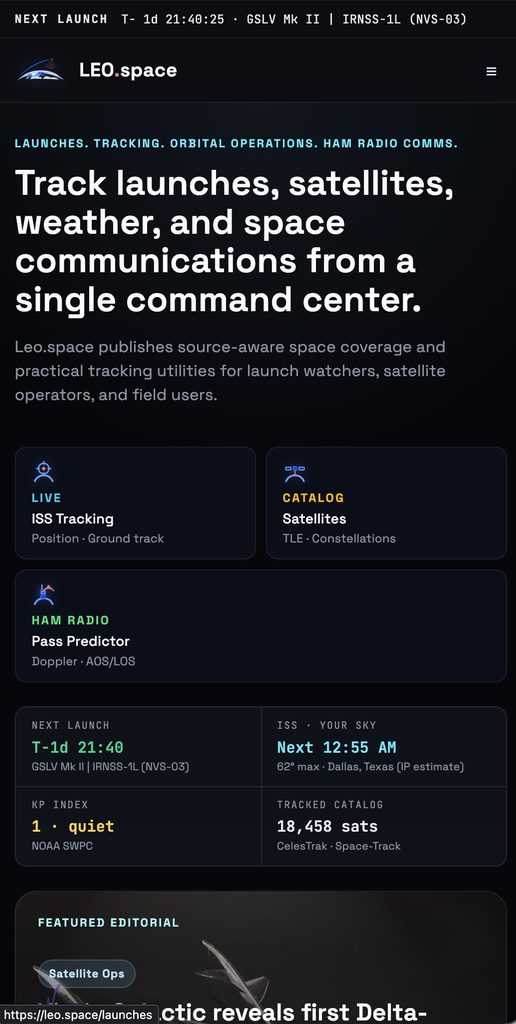
That’s where LEO.space lands. Launched as a free, independent platform in 2026, it was built exactly for people like us—hams who want clean, practical tools for Low Earth Orbit without the usual scavenger hunt across specialized databases.
From the home page the site greets you with the essentials: live ISS position (NORAD 25544), next launch info, Kp index, and a “Your Sky Now” panel that shows which amateur satellites are currently above your horizon. It fuses live orbital data, community status, and space-weather so you know what is potentially workable before you even pick up the radio.
The Ham Radio Heart of the Site
Head straight to /ham/passes. This is the operating desk.
- Enter your location (GPS or search) and the site computes upcoming passes for tracked amateur satellites.
- Each pass card gives AOS / MAX / LOS times, azimuths, a clear sky-arc diagram (horizon outer ring, 30° and 60° elevation rings), and the frequency plan you’ll need.
- Pass quality is graded: Overhead (60°+), Good (30–59°), Low, Marginal—so you instantly know which contacts are worth chasing.
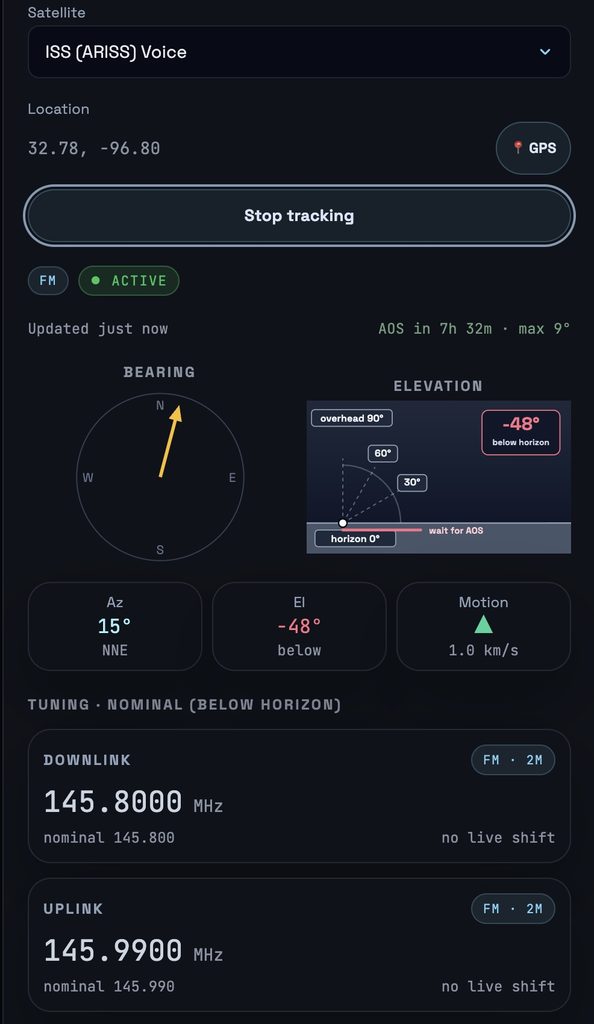
The Contact Console is built for real-time work. Set your callsign and grid, filter by mode (FM, SSB/CW, APRS, SSTV, Beacon), then hit “Start tracking.” You get live compass bearing, elevation, AOS/LOS countdowns, and uplink/downlink frequencies that are Doppler-corrected every second. Perfect for full-duplex handheld or mobile setups.Supporting field tools include:
- Live antenna aiming (real-time az/el + countdown)
- Mutual-pass sked finder (enter two Maidenhead grids and see overlapping windows)
- Address-to-grid converter and grid distance/bearing solver
- Linear transponder passband matcher (shows where your uplink and downlink sit in an inverting passband and accounts for Doppler phase)
- Session log that exports to ADIF
There’s even a practical pre-pass checklist: verify the bird is active (AMSAT status), program memories, set CTCSS (SO-50’s 74.4 Hz burst + 67.0 Hz, AO-91/92 67.0 Hz, ISS none), pre-aim at AOS azimuth, start low power, keep the contact short.
Space Weather That Actually Matters to Hams
The /space-weather page pulls live NOAA SWPC data: planetary Kp index and 72-hour forecast, real-time solar wind from DSCOVR, NASA SDO solar imagery (304 Å, 193 Å, visible), storm scales, and HF band-condition outlooks. High solar activity inflates the thermosphere and increases drag on low satellites while also affecting propagation and radio blackouts—exactly the information you need before planning a long session or a high-elevation pass.
Satellite Catalog and Tracking
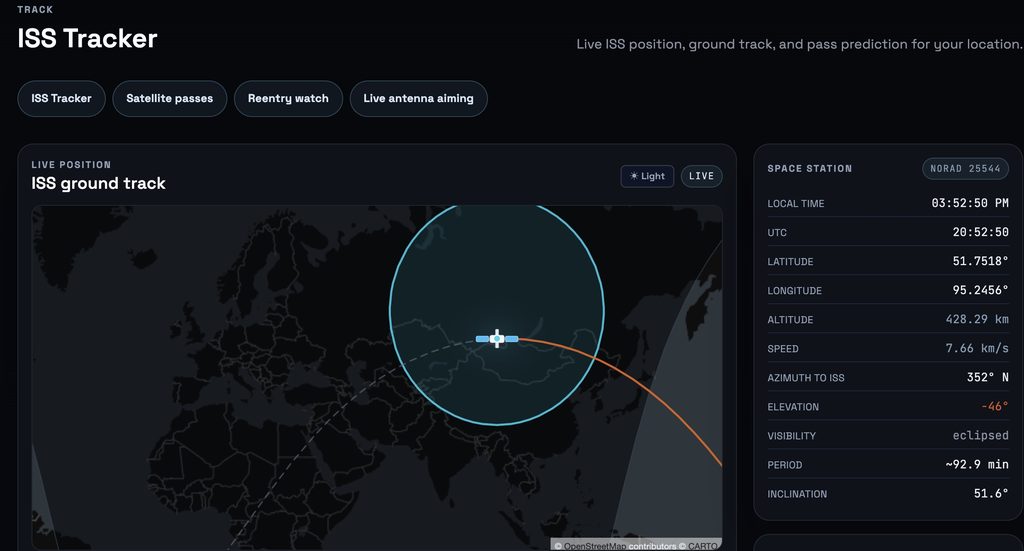
Browse the catalog at /sats for amateur satellites (SO-50, AO-91, AO-92, FO-29, AO-7 and others), ISS, and major constellations. The dedicated ISS tracker shows live position, ground track, and location-specific pass predictions. leo.space +1News and editorial content keep you current on launches, new CubeSats carrying amateur payloads, and broader LEO activity without leaving the site.
How to Get the Most Out of It
- Bookmark /ham/passes and /space-weather on your phone.
- Set your location and callsign once—the settings stick in the URL and cookies so you can share a pre-configured view.
- Use the date-range planner for Field Day or multi-day portable ops.
- Cross-check satellite health with AMSAT status before transmitting.
- Pair the live Doppler-corrected frequencies and passband matcher with your dual-band HT or full-duplex setup (Arrow/Elk + diplexer is still the classic portable combination).
- Log on-site and export ADIF later.
- Watch the “best pass in 24 h” and overhead-now panels so you never miss an easy high-elevation opportunity.
LEO.space doesn’t replace your radio or your antenna, but it collapses the planning friction that used to eat half the short 8–15 minute LEO window. One free browser tab now gives you passes, Doppler, aiming, weather, and status—exactly what a working ham needs.
Visit https://leo.space and start tracking.
Leave a Reply